Posts

HAARP Technology

Image
The High Frequency Active Auroral Research Program , or HAARP, is a research program designed to study the ionosphere and its interactions with the Earth's magnetic field . The program is located in Gakona, Alaska and is operated by the University of Alaska Fairbanks in partnership with the US military. HAARP is unique in its capabilities, as it uses high frequency radio waves to heat a specific area of the ionosphere and study its response. This allows researchers to gain a deeper understanding of the ionosphere and its role in the Earth's magnetic field and communication systems. One of the key features of HAARP is its ability to transmit extremely high frequency (EHF) radio waves , which are capable of penetrating the ionosphere and reaching the Earth's surface . This makes HAARP a valuable tool for studying the ionosphere and its interactions with the Earth's magnetic field. The ionosphere is an important part of the Earth's environment , as it helps to...

Black Holes vs Wormholes

Image
Black Holes vs Wormholes: Understanding the Differences Black holes and wormholes are two of the most intriguing structures in the universe, often discussed in both scientific and popular contexts. However, despite their similarities, black holes and wormholes are fundamentally different entities with distinct characteristics and properties .   Black Holes: Black holes are regions in space where the gravitational pull is so strong that nothing, not even light, can escape from them . They are formed from the collapse of massive stars and are characterized by their event horizons, which mark the boundary beyond which anything that enters a black hole cannot escape.   Wormholes: Wormholes, on the other hand, are hypothetical tunnels in the fabric of space-time that could potentially allow for faster-than-light travel and shortcuts between distant points in the universe . The idea of wormholes was first proposed by physicists Albert Einstein and Nathan Rosen in 193...

Wormholes

Image
Wormholes: The Cosmic Shortcuts of the Universe Wormholes are mysterious and fascinating structures that have captured the imagination of scientists and science fiction enthusiasts alike. They are hypothetical tunnels in the fabric of space-time that could potentially allow for faster-than-light travel and shortcuts between distant points in the universe . The concept of wormholes was first proposed by physicist Albert Einstein and mathematician Nathan Rosen in 1935 , as a solution to Einstein’s theory of general relativity. According to this theory, massive objects cause a curvature in space-time, and a wormhole could be thought of as a bridge between two points in space-time , providing a shortcut through this curved region. Wormholes have never been directly observed , and their existence remains a matter of scientific speculation. However, many physicists believe that they could exist based on mathematical models and theories , and some have even proposed ways to detect an...

Black Holes: The Ultimate Cosmic Conundrum

Image
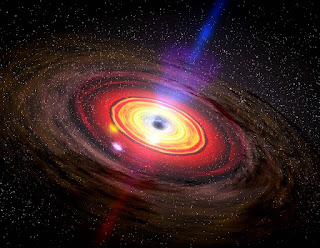
Black Holes: The Ultimate Cosmic Conundrum Black holes are among the most mysterious and awe-inspiring objects in the universe . They are regions of space where gravity is so intense that not even light can escape, making them invisible to the naked eye . However, their presence can be detected through the effects of their gravity on nearby matter. Black holes are formed when massive stars reach the end of their lives and collapse under their own gravity, creating a point of infinite density called a singularity surrounded by a boundary known as the event horizon . Beyond the event horizon, anything that enters a black hole is pulled towards the singularity and cannot escape. There are three main types of black holes: stellar, intermediate, and supermassive . Stellar black holes form from the collapse of massive stars and have masses several times that of the sun . Intermediate black holes are thought to bridge the gap between stellar and supermassive black holes and have mas...

Quantum Entanglement

Image
Quantum Entanglement: Exploring the Mysterious Connection Quantum entanglement is a fascinating and mysterious phenomenon in quantum mechanics. It states that the properties of two or more particles can be connected in such a way that the state of one particle can instantaneously affect the state of the other particle , even if they are separated by large distances. One of the key characteristics of entangled particles is that they can be correlated, meaning that the properties of one particle can be predicted based on the properties of the other particle . This correlation is stronger than what can be explained by classical physics, and it has been shown to hold true even when the particles are separated by large distances. The concept of quantum entanglement was first introduced by Albert Einstein, Boris Podolsky, and Nathan Rosen in 1935 , who referred to it as "spooky action at a distance." Despite its strange and seemingly paradoxical nature, quantum entanglem...

Quantum Theory / Quantum Mechanics

Image
  Quantum Theory / Quantum Mechanics: An Overview Quantum theory, also known as quantum mechanics , is a fundamental theory in physics that explains the behavior of matter and energy at the smallest scales , such as atoms and subatomic particles. It was developed in the early 20th century and has since become one of the most important and widely used theories in physics. One of the key concepts in quantum theory is that particles can exist in multiple states at the same time. This is known as superposition. Another important concept is entanglement, which states that the properties of two or more particles can be connected in such a way that the state of one particle can instantaneously affect the state of the other particle, even if they are separated by large distances. Another significant aspect of quantum theory is the idea of wave-particle duality . This states that particles, such as electrons, can exhibit both wave-like and particle-like behaviors . This idea is cen...

String Theory

Image
  String Theory String theory is a theoretical framework in physics that attempts to reconcile general relativity and quantum mechanics . It posits that the fundamental building blocks of the universe are not point-like particles, but rather one-dimensional objects known as strings. These strings vibrate at different frequencies, giving rise to the different types of particles we observe in the universe. The theory was first proposed in the late 1960s and early 1970s , and has since been developed and refined by a community of physicists and mathematicians. One of the key features of string theory is that it predicts the existence of extra dimensions beyond the four we are familiar with . These extra dimensions are compactified, meaning that they are curled up into tiny, unobservable sizes. One of the main motivations for string theory is the problem of quantum gravity . General relativity describes the behavior of objects in the large scale, but it does not incorporate qua...